

Samantha D'Onofrio
Director, Health Plan Market Lead
As healthcare organizations continue to focus on improving outcomes and reducing avoidable costs, one challenge remains consistent: identifying members who need support before a serious health event occurs.
Historically, many risk identification efforts have relied on utilization data such as hospital admissions, emergency department visits, or high-cost claims activity. While these indicators are valuable, they often signal that a problem has already developed.
What if organizations could identify risk earlier?
Pharmacy data and pharmacist interactions may provide some of the earliest indicators that a member is struggling, offering opportunities for proactive intervention before healthcare utilization increases.
Why Pharmacy Data Matters
Medications are often one of the most frequent touchpoints in a member’s healthcare journey.
A member may see their primary care provider only a few times each year, but prescriptions, refills, medication changes, and pharmacist interactions create a continuous stream of information about their health status and behaviors.
Medication-related insights can reveal changes in routine, emerging barriers, or declining engagement long before they appear in claims data.
There’s also a timing advantage. Pharmacy claims are typically processed in near real time, while medical claims can take weeks or even months to arrive. By the time a hospitalization shows up in medical claims data, the warning signs may have been visible in pharmacy activity for some time.
These signals can help healthcare organizations move from a reactive approach to a more proactive population health strategy.
Early Warning Signs Often Appear in Medication Patterns
Rising-risk members rarely experience a sudden decline. More often, risk develops gradually through a series of small changes.
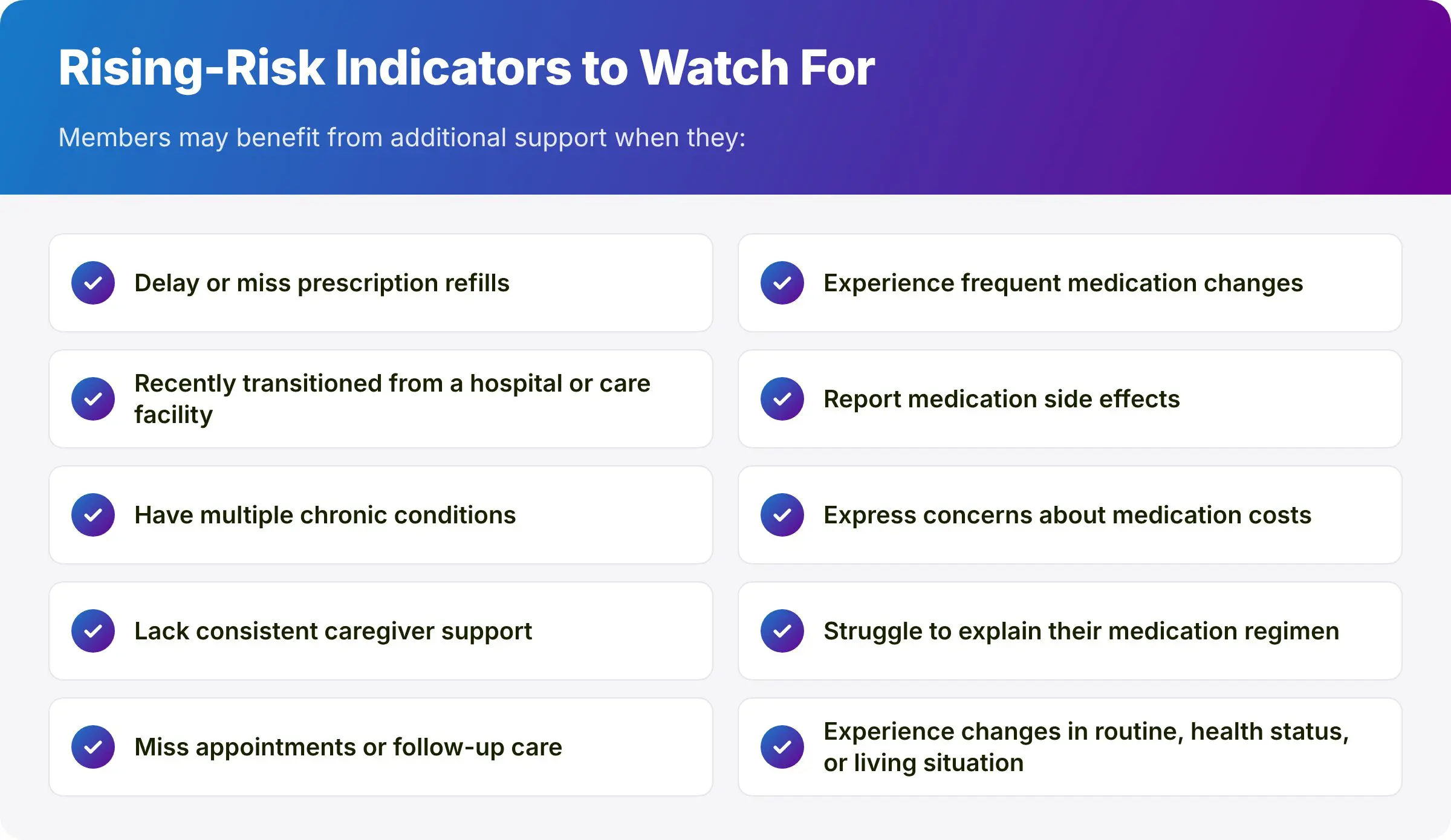
Pharmacy-related indicators may include:
- Delayed prescription refills
- Increased medication complexity
- New high-risk medications
- Frequent medication changes
- Multiple prescribers involved in care
- Questions about affordability
- Reports of side effects
- Missed opportunities for medication reviews
Individually, these events may seem minor. Together, they can tell an important story about a member’s ability to manage their health.
For example, a delayed refill may seem like a simple oversight. However, the underlying cause could be transportation challenges, financial hardship, caregiver changes, declining cognition, or worsening health status.
Understanding the “why” behind the behavior creates an opportunity for earlier intervention.
Medication Adherence Can Predict Future Risk
Medication adherence is one of the clearest indicators of a member’s likelihood to achieve positive health outcomes.
When members consistently take medications as prescribed, they are generally better positioned to manage chronic conditions, avoid complications, and maintain stability.
Conversely, gaps in medication adherence often signal increased risk. The cost of this gap is significant. According to the CDC, non-adherence is associated with higher hospital admissions and direct heath care costs of roughly $100-$300 billion annually in the U.S.
Members may be struggling with:
- Cost concerns
- Health literacy challenges
- Transportation barriers
- Complex medication regimens
- Behavioral health concerns
- Caregiver support issues
- Chronic disease progression
These barriers frequently emerge before a hospitalization or emergency department visit occurs.
Organizations that monitor adherence trends can identify members who may benefit from additional outreach and support before a preventable event takes place.
The Power of Combining Pharmacy Insights with Care Management
Pharmacy data becomes even more valuable when combined with information from care management teams.
Pharmacists may identify medication-related concerns such as:
- Late refills
- Therapy changes
- Drug interactions
- Adherence challenges
Case managers often identify:
- Social determinants of health (SDoH)
- Transportation barriers
- Food insecurity
- Housing instability
- Caregiver challenges
- Recent life events
Together, these perspectives create a more complete picture of member needs.
A member who misses refills may also be missing appointments due to transportation challenges. A caregiver supporting medication management may be experiencing burnout. A recent hospitalization may have created confusion about medication changes.
No single data point tells the full story. When organizations connect pharmacy insights with broader care management information, opportunities for intervention become much clearer.
One missed prescription, one root cause
Referred by: Health plan pharmacy leader-
1
Pharmacy insight
During onboarding, our Health and Medication Review revealed the member was just discharged from the hospital and hadn't filled a new prescription.
-
2
The real barrier
An SDoH screening uncovered why: no reliable transportation.
-
3
Immediate action
We delivered the medication directly to the member's home.
-
4
Loop closed
We shared our findings with the plan's pharmacy and case management teams so they could address transportation going forward.
Care Transitions Create Critical Opportunities
Hospital discharges and other care transitions remain one of the highest-risk periods for medication-related issues.
Following discharge, members often return home with:
- New prescriptions
- Medication discontinuations
- Updated instructions
- Multiple provider follow-ups
Confusion during this period is common.
Pharmacy teams can help identify prescription delays, medication discrepancies, and adherence concerns, while care management teams can address barriers related to appointments, transportation, education, and caregiver support.
Monitoring medication activity following a transition of care can help organizations identify members who may require additional outreach before complications occur.
Health Literacy Is Often the Hidden Risk Factor
Many members want to follow their care plans but struggle to understand the information they have been given.
Medication instructions, discharge paperwork, and chronic condition management plans can quickly become overwhelming, particularly for members managing multiple conditions.
Signs of health literacy challenges may include:
- Difficulty explaining medication purpose
- Confusion about dosing schedules
- Frequent questions about medications
- Reliance on caregivers for medication management
- Missed appointments or follow-up care
Pharmacy interactions can provide valuable insight into these challenges.
Members who repeatedly ask similar questions or appear uncertain about medication instructions may benefit from additional education and support.
Addressing health literacy barriers can improve medication adherence and reduce future healthcare utilization.
Identifying Risk Earlier Benefits Everyone
The ability to recognize rising-risk members before healthcare utilization increases benefits members, providers, health plans, and care teams alike.
Early intervention can help:
- Prevent avoidable hospitalizations
- Reduce emergency department utilization
- Improve medication adherence
- Enhance care coordination
- Support caregivers
- Improve member engagement
- Strengthen chronic condition management
Perhaps most importantly, it allows organizations to address problems while they are still manageable.
Looking Ahead
Healthcare organizations have access to more information than ever before, but successful population health management is not simply about collecting data. It is about identifying meaningful signals and acting on them early.
Pharmacy insights provide a unique window into member behavior, health status, and potential barriers to care. When combined with care management, social determinants of health, and member engagement efforts, these insights can help organizations identify rising-risk populations before utilization increases.
The future of population health depends not only on responding to risk, but on predicting it. Pharmacy teams are uniquely positioned to help make that possible.