


Samantha D'Onofrio
Director, Health Plan Market Lead
Healthcare is becoming increasingly complex. Members often see multiple providers, manage chronic conditions, navigate medication changes, and face social or financial barriers that affect their ability to follow care plans.
In this environment, no single team can address every challenge alone.
That’s why collaboration between pharmacy and case management teams is more important than ever. While each brings unique expertise, both share a common goal: helping members achieve better health outcomes.
When these teams work together, organizations can identify risks earlier, close care gaps faster, improve medication adherence, and create a better experience for the members they serve.
For many organizations, a clinical pharmacy partner can help strengthen that collaboration by bringing focused medication expertise, proactive member outreach, and ongoing visibility into adherence barriers. Rather than replacing the work of case managers or internal pharmacy teams, the right partner can help extend their reach and surface medication-related risks that may otherwise go unnoticed between care interactions.
The Challenge: What Happens Between Appointments
Many healthcare interactions happen in brief moments. A member visits a physician, receives a new prescription, completes a hospital discharge, or attends a follow-up appointment. What happens between those encounters often determines success.
Members may:
- Miss doses
- Delay refills
- Misunderstand medication instructions
- Experience side effects
- Struggle with transportation
- Face financial barriers
- Become overwhelmed by complex treatment plans
This is where care teams often lose visibility: the member leaves the clinical setting, medication instructions become part of daily life, and barriers begin to surface outside the appointment. The timeline below shows how quickly those barriers can appear between formal care touchpoints.
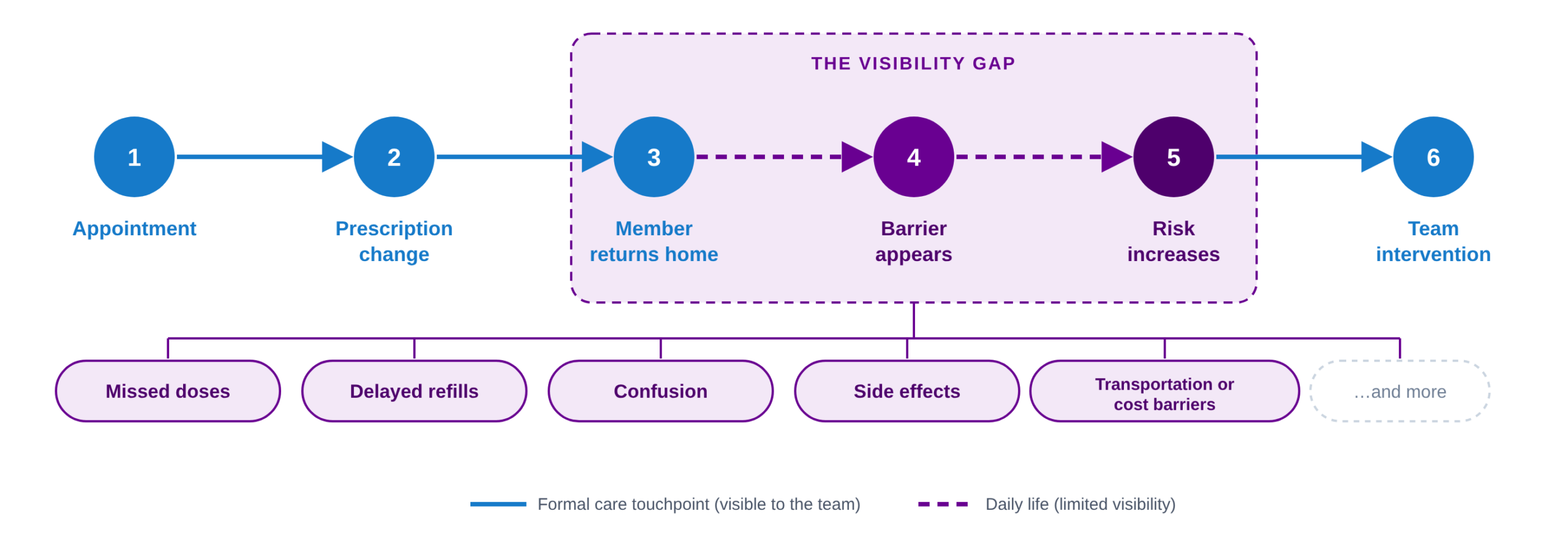
Without this kind of visibility, issues that begin as small barriers can contribute to worsening health conditions, avoidable emergency department visits, hospitalizations, and preventable care gaps.
The challenge isn’t always a lack of care. Often, it’s a lack of visibility into the barriers members face once they return home.
Different Perspectives, Shared Goals
Case management and pharmacy teams view member needs through different lenses.
| Case Managers Often Focus On | Pharmacy Teams Often Focus On |
|---|---|
|
Care coordination |
Medication adherence |
|
Transitions of care |
Medication safety |
|
Social determinants of health (SDOH) |
Refill patterns |
|
Member engagement |
Member engagement |
|
Health education |
Clinical interventions |
|
Resource connections |
Medication education |
|
Long-term health goals |
Optimization of therapy |
Independently, each team can uncover valuable insights. Together, those insights create a more complete picture of member health.
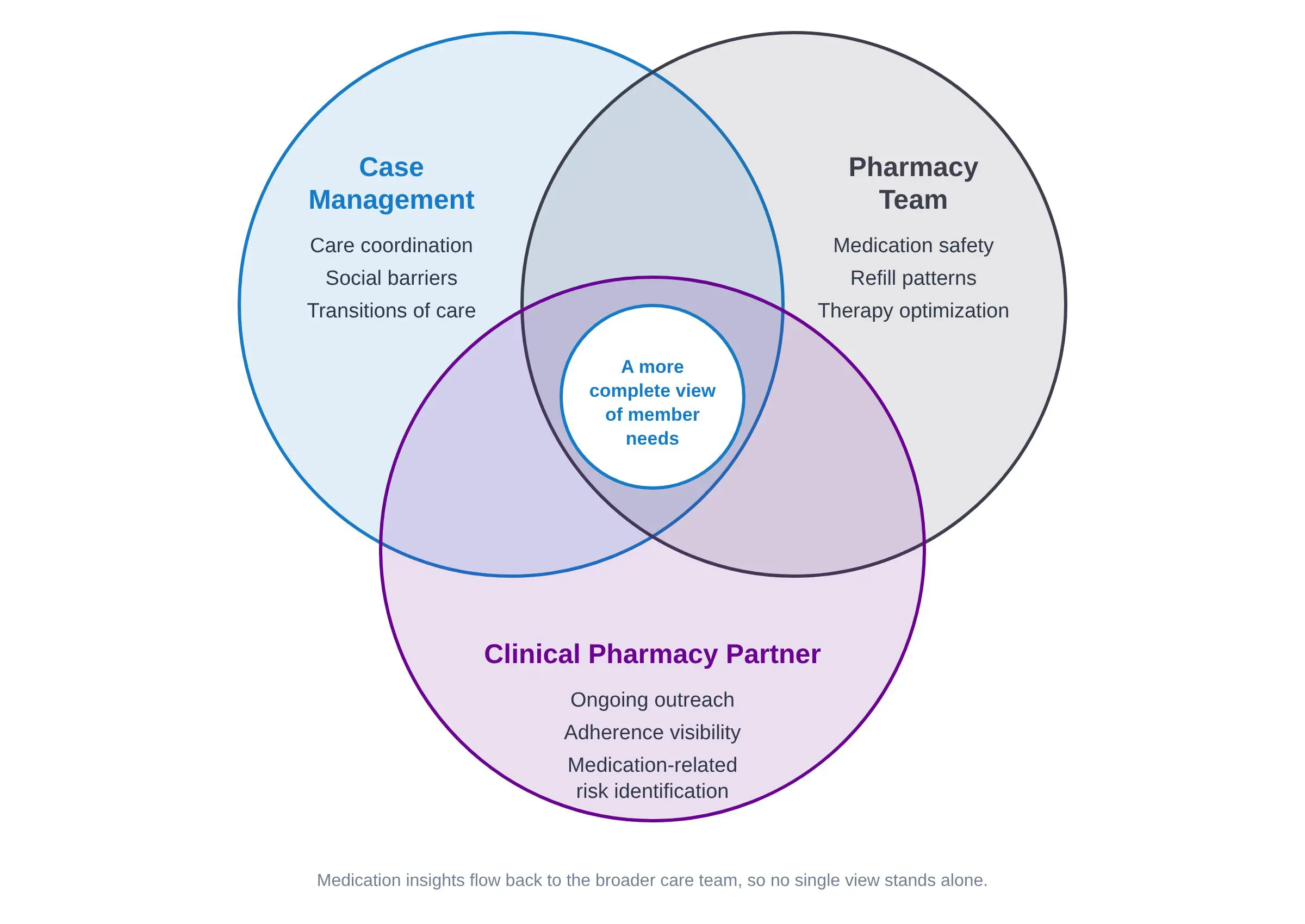
When a clinical pharmacy partner is part of that collaboration, organizations can add another source of medication-specific visibility and support. This can be especially valuable for members managing multiple medications, frequent therapy changes, cognitive challenges, caregiver involvement, or social barriers that affect consistent medication use.
The graphic below illustrates how each perspective contributes to a more complete view of member needs, especially when a clinical pharmacy partner helps connect medication-related insights back to the broader care team.
Where a Clinical Pharmacy Partner Can Add Support
Case managers and health plan pharmacy teams already play essential roles in supporting members. A clinical pharmacy partner can complement that work by helping identify medication-related barriers, reinforcing education, monitoring adherence patterns, and engaging members between formal care touchpoints.
In my work with health plans, one of the most important questions is how that support fits into the teams’ existing workflow. Case managers want to understand which members may benefit, how to explain the service, and how to connect them with the pharmacy. Joining existing team meetings, providing practical referral tools, and establishing clear points of contact can help turn a partnership into something teams can use in their daily work.
This support does not add another disconnected layer to the member experience. When integrated thoughtfully, it can help bring medication insights back to the broader care team so case managers and pharmacy teams have a clearer understanding of what members are experiencing day to day.
That added visibility can help teams intervene earlier, tailor outreach more effectively, and coordinate support around the member’s real-world needs, rather than relying only on what is visible during appointments, claims reviews, or isolated follow-up calls.
Medication Adherence Is a Team Sport
Medication non-adherence remains one of the most common barriers to achieving positive health outcomes. Yet the reasons behind missed medications are rarely simple.
The callout below captures the core idea: a missed refill is rarely just a refill issue. It can be a signal that a member needs additional support from multiple parts of the care team.
A missed refill may be a medication issue or it could be... transportation. cost. a caregiver. health literacy.
That is why medication concerns are often best understood through more than one lens.
A case manager may discover the member recently lost transportation, moved residences, or is struggling to afford medications.
Neither insight alone tells the full story. Together, they create an opportunity for intervention.
From a partnership perspective, the handoff is just as important as identifying the need. Teams should know who will contact the member, who will resolve medication questions with the prescriber, and how unresolved barriers will be communicated back. A referral starts the process; clear ownership and follow-through help ensure the member receives support.
When pharmacy and case management teams share information and collaborate on solutions, members are more likely to receive the support they need before a care gap develops.
Identifying Risk Earlier
One of the greatest benefits of collaboration is the ability to identify rising-risk members before healthcare utilization increases.
Pharmacy teams frequently see early warning signs through medication-related activity, including:
- Late refills
- Increasing medication complexity
- Frequent therapy changes
- Member questions about medications
- Reported side effects
Case management teams often identify other indicators, such as:
- Missed appointments
- Recent hospitalizations
- Changes in caregiver support
- Food insecurity
- Housing concerns
- Transportation barriers
When organizations combine these insights, they can proactively engage members who may benefit from additional support, rather than waiting for a crisis to occur.
Supporting Members Through Care Transitions
Transitions of care are among the highest-risk periods for medication-related issues. Following a hospitalization or discharge from a skilled nursing facility, members may return home with:
- New prescriptions
- Discontinued medications
- Updated instructions
- Multiple follow-up appointments
These transitions often create confusion. Pharmacy teams can help identify medication discrepancies, conduct medication reviews, and reinforce education. Case managers can help ensure follow-up appointments occur, address barriers to care, and connect members to needed resources.
Together, they help members navigate what can otherwise be an overwhelming experience.
Improving Health Literacy and Member Understanding
Studies consistently show that many individuals struggle to understand health information, medication instructions, or care plans. Members may hesitate to admit they are confused or simply answer “yes” when asked if they understand.
Case managers and pharmacy professionals both play important roles in improving health literacy by:
- Using plain language
- Avoiding medical jargon
- Encouraging questions
- Confirming understanding through teach-back methods
- Involving caregivers when appropriate
When healthcare information is easier to understand, members are more likely to follow treatment plans and make informed decisions about their health.
Caregivers Are Part of the Care Team
For older adults and individuals managing multiple chronic conditions, caregivers often play a critical role in medication management and care coordination.
However, caregivers themselves may feel overwhelmed by complicated medication schedules, frequent provider visits, and changing care plans.
Cross-functional collaboration can help ensure caregivers receive:
- Consistent information
- Clear medication instructions
- Reinforcement of key messages
- Access to community resources
- Support during transitions of care
When caregivers are supported, members are more likely to experience positive outcomes.
Building a More Connected Member Experience
Members do not think about healthcare in terms of departments or organizational structures. They simply want their healthcare experience to feel connected.
When pharmacy and case management teams collaborate effectively, members experience:
- More consistent communication
- Better care coordination
- Fewer medication-related issues
- Easier access to support
- Greater confidence in managing their health
The result is a more seamless experience that helps members feel supported throughout their healthcare journey.
Looking Ahead
Healthcare organizations continue to face growing pressure to improve outcomes, reduce avoidable utilization, and enhance member experiences.
Achieving these goals requires more than isolated interventions. It requires collaboration.
When pharmacy and case management teams work together, they create opportunities to identify risks sooner, address barriers more effectively, support caregivers, and help members stay on track with their health goals.
As healthcare organizations look for more connected ways to support members, clinical pharmacy partners can play an important role in helping bridge medication management, care coordination, and member engagement. The strongest outcomes often occur when medication expertise, case management insight, and ongoing member support come together around a shared purpose: helping people live healthier lives.